Málaga's own songs
Malagueña and verdiales
The two songs most tied to Málaga: how the malagueña grew from the local fandango, how verdiales are played in the hills, and what each sounds like.
Book the El Gallo Ronco show ↗Quick answer
The malagueña is a sung form that developed from the old Málaga fandangos and took flamenco form in the first half of the 1800s. Verdiales are the hill-village songs of the Montes de Málaga, played by pandas. Both are local to Málaga, though a tablao programme is chosen by the artists and cannot be promised.
The fandango behind both
Both songs grew from the fandango, a dance type that became very popular across much of Spain in the eighteenth century, according to Wikipedia. The malagueña is a local variety of the fandangos, and the earliest versions were sung and played fast, in a six-beat rhythm for dancing. The verdiales, still played by large non-professional groups called pandas, are a surviving form of those early fandangos. That shared root explains why a flamenco evening in Málaga can include sounds that feel older and more rural than the dance-heavy parts of the programme.
How the malagueña sounds
The Junta de Andalucía's flamenco portal describes the malagueña as a song of four or five eight-syllable lines, often extended to six by repeating one, sung in free rhythm with the guitar playing above the voice. It is valued for its melody and is not meant for dancing. Wikipedia adds that the melodies are lyrical and ornate, that mellow voices have traditionally suited the style, and that singers often move into a livelier fandango after several verses. Listen for the unhurried line, the long phrases and the change of pace at the end.
The singers who shaped it
Wikipedia names Antonio Chacón as the most prolific creator of malagueñas, with most of his styles recorded between 1909 and 1928, and says Enrique el Mellizo is often said to have based his version on the preface to the Catholic Mass. His influence removed the guitar's rhythmic pattern and made the song a free-rhythm cante. Juan Breva, born in Vélez-Málaga in 1844, is the singer most tied to Málaga itself, and the Junta's list of notable interpreters adds La Trini and El Pena.
Where verdiales are played
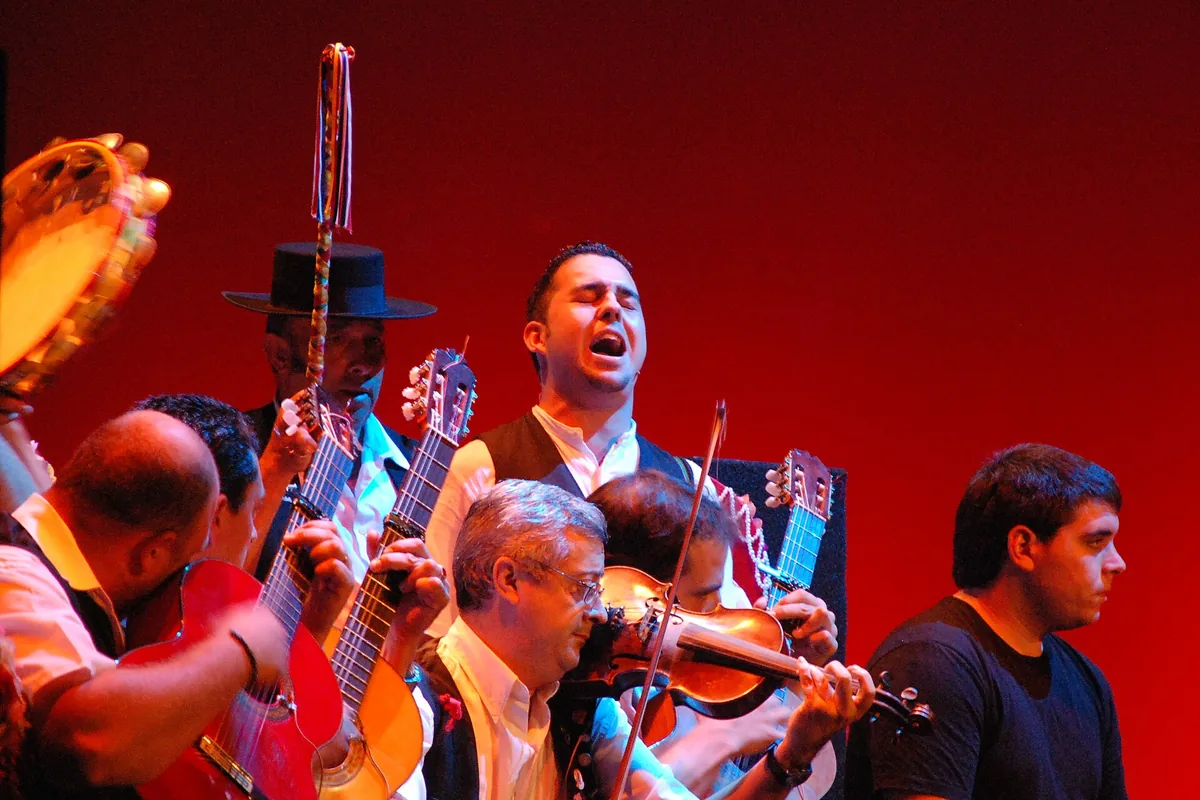
Verdiales belong to the villages of the Montes de Málaga, Almogía and Comares, and they have three principal styles named after those areas. They are performed by pandas, groups that include singers, dancers and instrumentalists playing violin, guitars, a tambourine or frame drum, small cymbals and castanets. The main celebration, the Fiesta Mayor de Verdiales, is held around 28 December, the day of the Holy Innocents. The tradition is recognised as a Bien de Interés Cultural, which gives it formal protection as an ethnological activity.
Folk and flamenco, side by side
Wikipedia notes that in flamenco terminology verdiales are usually treated as a palo in the family of the cantes de Málaga, and that they remain a rural folk practice independent of professional flamenco. The two ideas are both true. A panda in the hills plays for a village fiesta, and a flamenco artist on a stage may borrow a verdiales rhythm. The practical point for a visitor is that Málaga's music includes a living folk tradition as well as the stage form, and that the two meet in the city.
Hearing them in Málaga
A tablao show is chosen by the artists on the night, so neither song can be promised at El Gallo Ronco. A visitor who wants verdiales specifically would look for the December fiesta in the hills or for a festival programme. A malagueña is more likely to arise in a flamenco programme of any size, since it is one of the classic sung forms. Ask no one to perform on request; listen, and let the programme surprise you. If a malagueña does appear, notice that the guitar leaves the singer room, and that the song may close on a livelier fandango, as the Junta's portal describes.
Who this isn't for
Look elsewhere if you need a precise programme for a given night, or a technical analysis of the harmony. Its aim is orientation: two names to listen for, where they come from, and why they belong to Málaga. It also says little about the dancing side of flamenco, since neither song is mainly a dance, and it makes no claim about what any particular tablao will perform on any given night.
Frequently asked questions
Is the malagueña danced?
Rarely. Wikipedia says it is very rarely danced, and the Junta's flamenco portal says it is not for dancing. It is valued as a sung form.
When is the verdiales festival?
The Fiesta Mayor de Verdiales is held in Málaga around 28 December, the day of the Holy Innocents, according to Wikipedia.
Sources