The songs, the history, what to listen for
Flamenco in Málaga, explained
What flamenco is, which songs belong to Málaga (the malagueña and verdiales), how the cafés cantantes and the peña shaped the city's scene, and what to listen for in one evening.
Book the El Gallo Ronco show ↗Quick answer
Flamenco is song, dance and guitar from Andalusia, inscribed by UNESCO in 2010. Málaga has songs of its own: the malagueña, which took flamenco form in the nineteenth century, and the verdiales of the hill villages. A one-hour tablao show cannot cover everything, so listen for the guitar's pulse, then the voice, then the feet, and let the artists choose the order.
What UNESCO recognised
In 2010 UNESCO placed flamenco on its Representative List, a register of the world's intangible cultural heritage. Its entry sets out three strands, the sung cante, the danced baile and the guitar toque, along with castanets, handclaps and foot-stamping, and says the art is performed at religious festivals, ceremonies and private celebrations. Andalusia is named as the heartland, with Murcia and Extremadura as further roots, and the Gitano (Roma) community is credited with an essential role in its development. UNESCO adds that the art travels down through families, dynasties, social circles and flamenco clubs, which is why a Málaga peña appears later in this guide. It is a living practice and not a museum piece: UNESCO calls flamenco a badge of identity for many communities and groups.
Where Málaga fits in
Flamenco is Andalusian rather than local to one city, and its first written traces point to Jerez de la Frontera in the late eighteenth century, according to Wikipedia. Málaga's contribution is a family of songs known as the cantes de Málaga, which grew out of the local fandango. The Junta de Andalucía's flamenco portal says the malagueña comes from the old fandangos of Málaga. Two songs matter to a visitor: the malagueña, a sung form of the city, and the verdiales, played by village bands in the hills behind it. Both are worth listening for, even if the programme never names them. A tablao show in Málaga is first of all a flamenco show, and the local songs appear when the artists choose them.
Verdiales, the hill-village sound
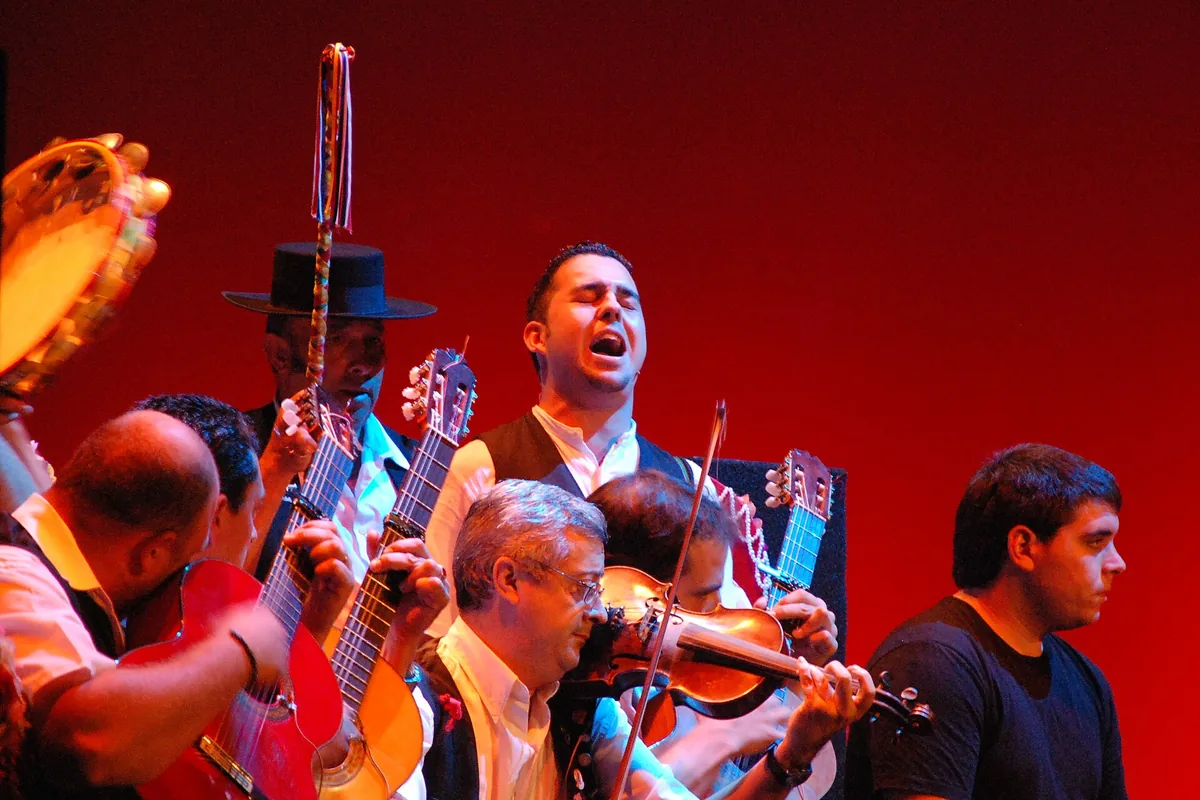
Verdiales come from the villages of the Montes de Málaga, Almogía and Comares, and they remain a rural folk practice that exists independently of professional flamenco. Wikipedia describes them as closely related to the fandango and as a survivor of the earliest Málaga fandango tradition. They are played by pandas, bands that combine singers, dancers, violin, guitars, a tambourine or frame drum and small cymbals. The main celebration, the Fiesta Mayor de Verdiales, takes place around 28 December, the day of the Holy Innocents, and the fiesta is recognised as a Bien de Interés Cultural. The groups are non-professional, which is why verdiales feel different from a polished stage programme.
The malagueña and its makers
The malagueña grew out of the old fandangos of Málaga and became a flamenco style in the first half of the nineteenth century, according to the Junta de Andalucía. It is sung in free rhythm, valued for its melody, and often ends on a livelier fandango. Wikipedia names Antonio Chacón as the most prolific creator of malagueñas and Enrique el Mellizo as the singer who moved it towards free rhythm. Juan Breva, born in Vélez-Málaga in 1844, is the singer most tied to the city; he recorded three of his styles in the early twentieth century, and Lorca is quoted as contrasting his giant frame with a high, light voice. You need not recognise a malagueña to enjoy one; notice a long, unhurried melodic line over the guitar.
Cafés cantantes, and a dancer in a Málaga café
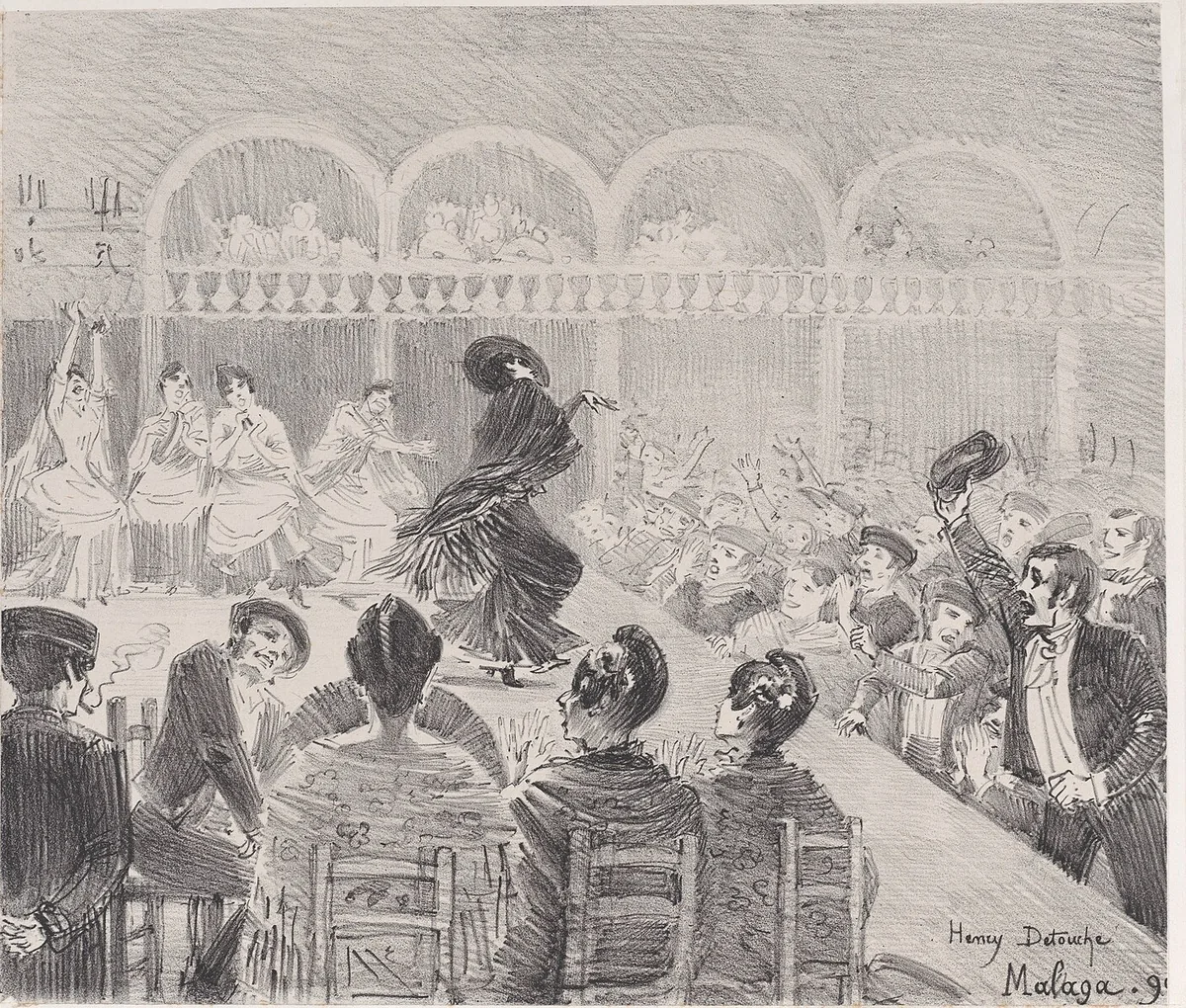
Flamenco moved from family gatherings to paid stages in the nineteenth century. In 1881, Wikipedia notes, Silverio Franconetti opened Seville's first flamenco singer café, and Málaga had its own circuit: a local flamenco guide counts more than fifteen cafés cantantes around Plaza de la Constitución from the mid-nineteenth century. The lithograph shown here, signed Henry Detouche with the word Málaga, shows a dancer in a black shawl on a café stage, with singers seated behind her and the audience pressed close. It is a drawing rather than a photograph, but the closeness it shows is the same closeness a small tablao sells today. In that sense a tablao is a descendant of the café stage.
Málaga remembers its singers
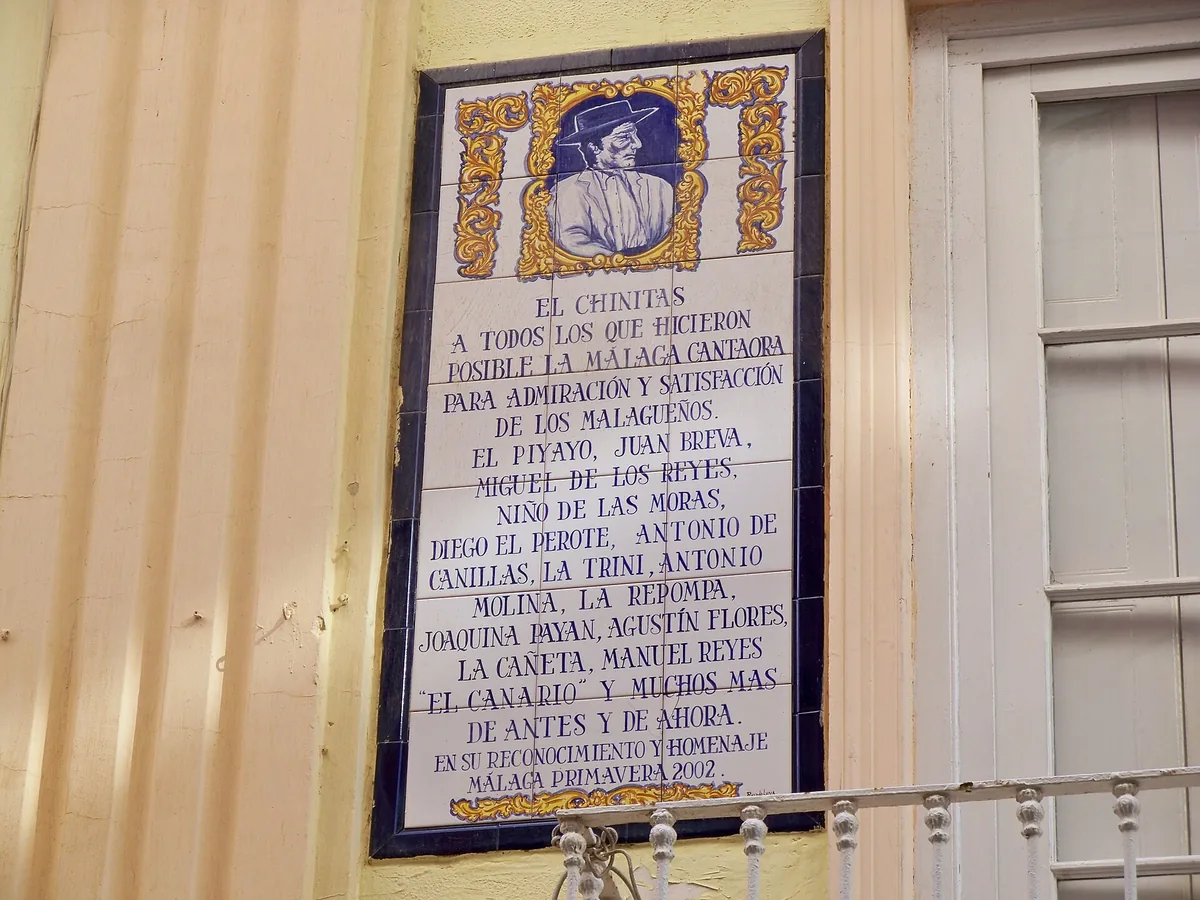
The old centre carries reminders of this history. On the front of a restaurant called El Chinitas, on Calle Moreno Monroe, a tile plaque set up in spring 2002 honours the people who made Málaga a city of singing. The names on it include Juan Breva, La Trini, El Canario and El Piyayo. The plaque is a quick lesson in how many singers the city counts as its own. Reading the names is an easy way to start listening for the Málaga sound before the show begins. A plaque like this is free to read and needs no ticket. The date printed on the tile is spring 2002, and the portrait at its top is labelled El Chinitas.
The peña and its museum
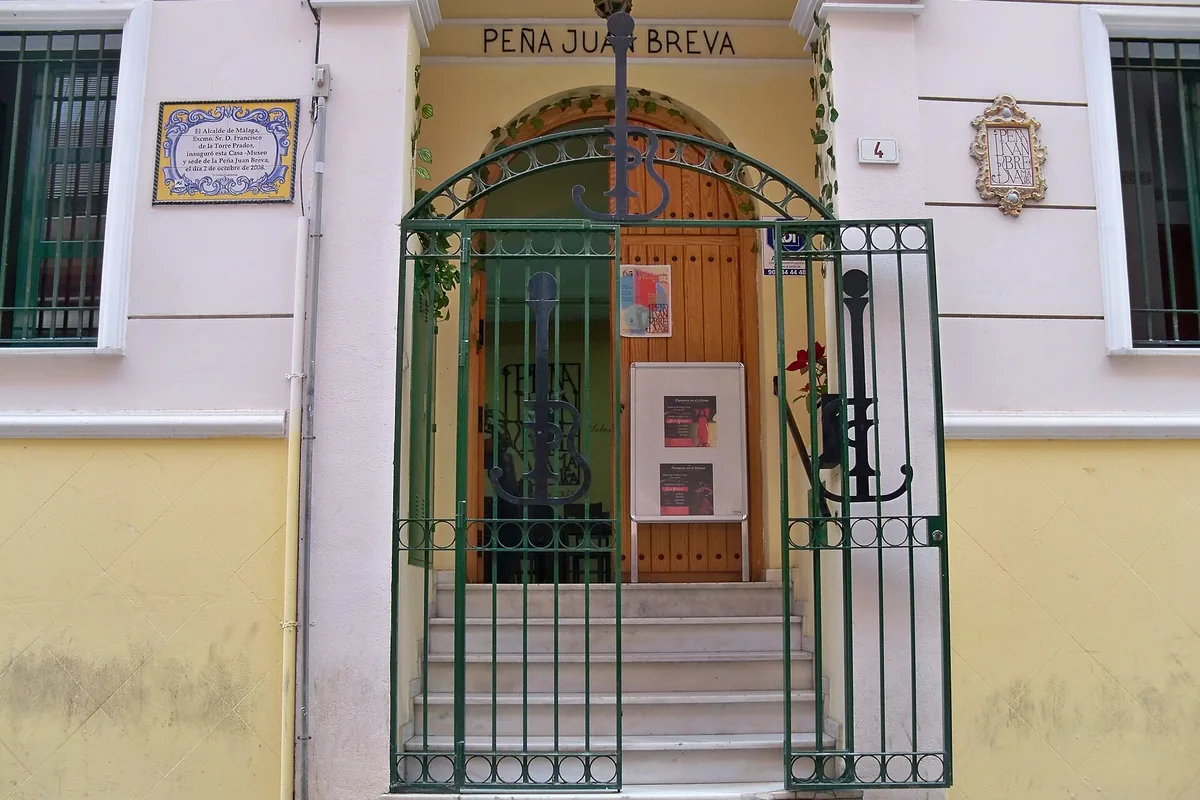
A peña is a flamenco club, the kind of social group UNESCO names as one of the ways the art is handed on. Málaga's best known is the Peña Juan Breva, founded in 1958 in homage to the singer and housed in a building on Calle Ramón Franquelo, in the old centre. The Andalusian tourism board lists its Museum of Flamenco Art there, and the building houses the club and the museum together. A tablao is a place to watch a show; a peña is where the community around the art keeps it going, among singers, guitarists and listeners who meet outside the commercial circuit.
A tablao, a peña, a restaurant show
In Wikipedia's wording, a tablao is a venue for flamenco performances, and the term also covers the dance floor. The formats a visitor meets in Málaga differ mainly in what surrounds the performance. A tablao such as El Gallo Ronco sells a ticketed show of about an hour. A restaurant show builds the performance into a meal, with food bought during it. A peña is a club for members and enthusiasts and is not set up as a show for passing visitors. Knowing which of the three you have booked explains most of what happens on the night. El Gallo Ronco is the first format, so judge it as a ticketed hour of flamenco, not as a meal or a members' evening.
What to listen for in an hour
Start with the compás, the rhythmic cycle of the palo, which the guitar and the handclaps (palmas) carry. Then follow the voice, and last the feet. Soleá, a basic palo often played with just one guitar, has a twelve-beat cycle and a serious mood. Siguiriya belongs to the deep song and counts twelve beats, stressing one, three, five, eight and eleven. Tangos run in a four-beat pulse and are often lively, and that steady pulse makes them the easiest entry point for a newcomer to follow with a foot. The artists choose the programme, so none of these is guaranteed. They are a listening kit, and the other guides on this site go into more detail on the Málaga songs.
- Soleá: twelve beats, serious mood
- Siguiriya: deep song, stress on beats 1, 3, 5, 8 and 11
- Tangos: four-beat pulse, often lively
- Palmas: the handclaps that keep the compás
Etiquette in a small room
Flamenco has its own tradition of audience voices (Wikipedia ties the word jaleo to the verb jalear, to encourage): jaleos are the encouraging calls, often arza or olé, that mark a moment the performers have just delivered. A newcomer is safest following the room rather than leading it. The ticket's terms add a practical rule of their own: once the show has started the doors are closed, and entry is only between acts. Arrive on time, settle in before the lights change, and save conversation for the pauses between pieces so that the singer's voice carries over the room. The same logic applies to applause: the end of a piece is the safe moment.
Who this isn't for
Pass on this one if you only want to know the practical details of one ticket; the El Gallo Ronco tickets guide covers those. It also does not replace hearing the music. A visitor who wants a formal lesson in flamenco technique needs a class, and one who wants a museum visit has the Museum of Flamenco Art, which keeps its own hours that are worth checking before you go. Treat a tablao show as a performance to feel before it is a subject to study, and let the background above sit quietly in the back of your mind while the singer works. If you remember only one idea, make it the guitar's pulse: the rest of the evening hangs from it.
Read next: El Gallo Ronco tickets
Frequently asked questions
Is flamenco from Málaga?
Flamenco is an Andalusian art, not one city's. Málaga has its own songs within it, chiefly the malagueña and the verdiales of the hill villages. Wikipedia's first written trace of flamenco points to Jerez de la Frontera in the late eighteenth century.
What is a malagueña?
A song of Málaga that developed from the local fandangos and took its flamenco form in the first half of the 1800s. It is sung in free rhythm and valued for its melody, and it is rarely danced.
What are verdiales?
A folk song and dance tradition from the villages of the Montes de Málaga, Almogía and Comares, played by bands called pandas. The Fiesta Mayor de Verdiales is held around 28 December.
Who was Juan Breva?
A singer born in Vélez-Málaga in 1844 and tied above all to the malagueña. The Peña Juan Breva in Málaga carries his name and houses a flamenco art museum.
Will I hear a malagueña at my show?
Possibly, but the artists pick the programme on the night, so it cannot be guaranteed. Soleá, siguiriya and tangos are common in flamenco generally, and you can listen for each of them.
What is a peña?
A flamenco club, one of the social groups through which UNESCO says the art is passed on. The Peña Juan Breva in Málaga is the best known and has a flamenco art museum.
Sources
- UNESCO: Flamenco on the Representative List
- Junta de Andalucía flamenco portal: Malagueña
- Expoflamenco: Juan Breva's centennial
- Andalucía tourism board: Juan Breva Museum of Flamenco Art
- Guía Flama: el arte flamenco en Málaga
- The Flamenco article on Wikipedia
- Wikipedia article on the malagueña as a flamenco style
- Wikipedia article on verdiales